
The Pro’s Guide to Preventing Frozen Pipes in NC Crawl Spaces
Living in North Carolina, we often enjoy mild winters, but when a sudden “Siberian Express” or polar vortex dips down into the Piedmont, homeowners are frequently caught off guard. As a licensed contractor who has spent years performing emergency repairs in Fayetteville and the surrounding areas, I’ve seen firsthand how a single night of sub-freezing temperatures can cause catastrophic damage. If you want to prevent pipes from freezing in crawl space settings, you have to move beyond the basic advice you find in a generic hardware store flyer. You need a strategy that accounts for the specific physics of a ventilated foundation in a humid climate.
The Vulnerability of the Vented Foundation
Most North Carolina homes are built with vented crawl spaces to manage our high summer humidity. However, these vents become a liability in January. When wind-driven, sub-zero air enters these openings, it creates a “wind chill” effect under your home that can freeze a copper or PEX line in minutes. To prevent pipes from freezing in crawl space environments, your first priority is a total lockdown of the perimeter.
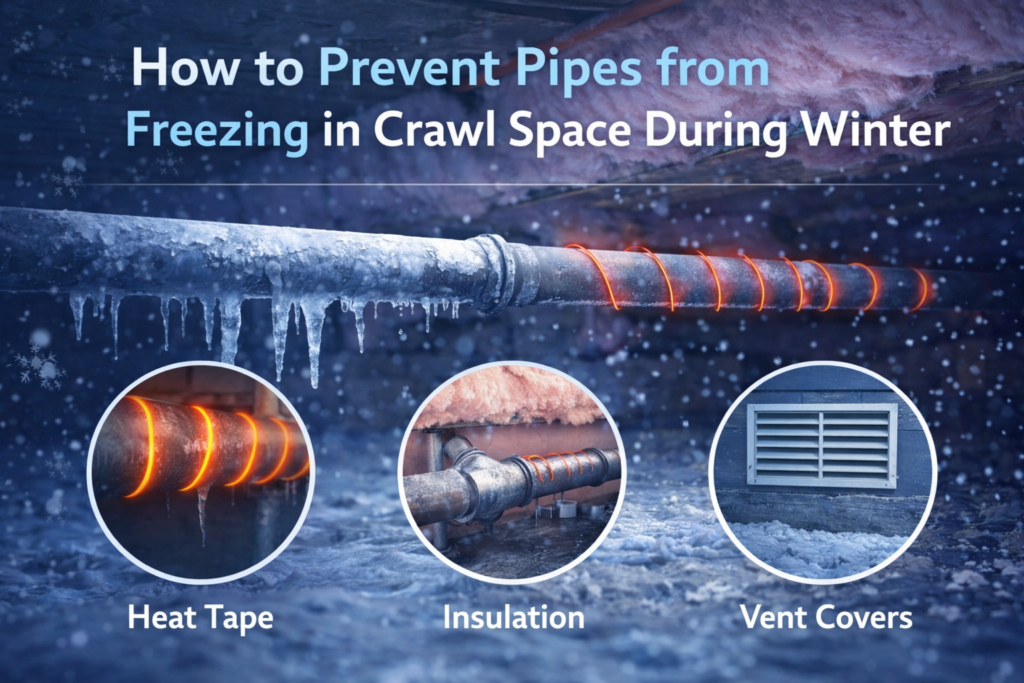
Do not rely on the plastic louvers built into your foundation vents; they are notoriously leaky. Instead, go to a local supply house and get 2-inch thick XPS (Extruded Polystyrene) foam board. Cut these into blocks that friction-fit into the vent openings from the inside. This creates an airtight thermal break. However, as a professional, I must give you this warning: you must remove these blocks when the weather warms up. If you leave them in during our humid spring, you are trading a burst pipe for a structural mold problem.
Advanced Insulation and Heat Application
Once the air entry is blocked, you must look at the pipes themselves. Generic foam sleeves are a start, but they often fail at the joints. When I’m under a house, I focus on the “thermal bridges”—the elbows and T-junctions where the pipe wall is stretched thinner. To effectively prevent pipes from freezing in crawl space areas, use miter-cut insulation on all angles and seal the seams with all-weather HVAC foil tape. Standard duct tape will lose its adhesive properties in the damp, cold environment of a crawl space.
For homes with high-exposure runs—pipes located within three feet of an exterior wall—standard insulation isn’t enough. In these cases, I install self-regulating heat cable. This is a smart technology that increases its heat output as the temperature drops. Always apply the cable directly to the pipe, under the insulation, and never overlap the cable, which can lead to a fire hazard.
Leveraging the House’s Natural Heat
One of the best-kept contractor secrets to prevent pipes from freezing in crawl space locations is “thermal bleed”. If you have a kitchen or bathroom sink located on an exterior wall, the pipes running up into the floor are at high risk. By keeping your sink cabinet doors open, you allow the 68°F+ air from your living room to circulate around those floor penetrations.
Additionally, stop using “setback” thermostat schedules during a hard freeze. Many homeowners drop their heat to 55°F or 60°F at night to save money, but that lower ambient temperature reduces the amount of heat radiating through the subfloor into the crawl space. Keeping a constant, steady temperature during a freeze can be the difference between a dry morning and a flooded home.
The Final Checklist
Before the first frost hits, disconnect your garden hoses. A hose full of water will back up pressure through the spigot and cause a burst inside the crawl space, regardless of how well you’ve insulated. Finally, know where your main water shut-off is located. In NC, these are often tucked away in a dark corner of the crawl space. Find it now, tag it with a bright ribbon, and ensure the valve actually turns.
By following these professional-grade steps, you can prevent pipes from freezing in crawl space zones and avoid the thousands of dollars in water damage that a single burst pipe can cause. Stay warm, stay dry, and keep that air out of your foundation.
About The Author