
Learn how to identify hydrostatic pressure leaks in basement floors and walls before your foundation cracks. Stop invisible water damage with our expert 2026 guide.
For many homeowners, a wet basement is a recurring nightmare that seems to have no clear origin, leading many to wonder how to identify hydrostatic pressure leaks in basement structures specifically. Unlike a burst pipe or a leaking window well, hydrostatic pressure is an invisible force caused by the weight of the water table pushing against your home’s concrete shell. When the soil surrounding your foundation becomes saturated with rainwater or snowmelt, that trapped liquid exerts an immense amount of physical force. If you don’t know how to identify hydrostatic pressure leaks in basement environments, you might mistake a serious structural threat for a simple case of high humidity.
The danger of this specific type of water intrusion is that it doesn’t always look like a flowing stream; instead, it often manifests as a slow, rhythmic “seeping” through the very pores of your concrete. Understanding how to identify hydrostatic pressure leaks in basement sections is critical because this pressure can eventually lead to bowed walls, shifted footings, and a compromised home value. In 2026, with shifting weather patterns causing more frequent flash floods, being able to spot these signs early is the only way to protect your investment and maintain a “leak sturdy” foundation.
The Science of Water Weight: Why Basements Fail
To truly grasp how to identify hydrostatic pressure leaks in basement rooms, you must first understand the physics at play beneath your feet. Hydrostatic pressure is essentially the pressure exerted by a fluid at rest due to the force of gravity. In a residential context, this happens when the “clay bowl” effect occurs—where the excavated area around your foundation fills with water that cannot drain away quickly enough. As this water builds up, it seeks any path of least resistance to relieve its own weight. This is why knowing how to identify hydrostatic pressure leaks in basement floors is often more important than checking the walls; the pressure is often highest at the lowest point of the structure.
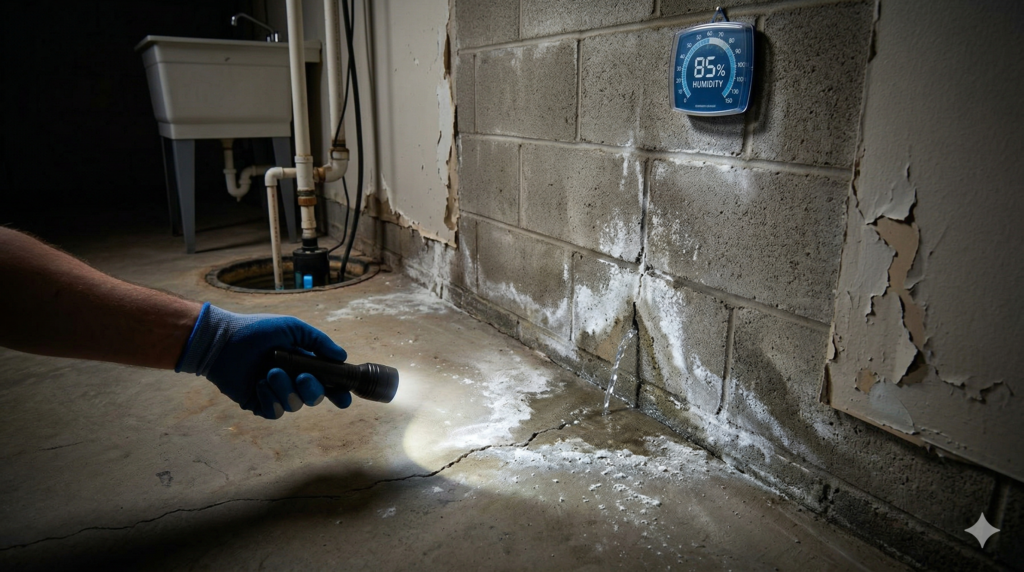
When you are learning how to identify hydrostatic pressure leaks in basement settings, look for water coming up through the “cove joint.” This is the thin line where your basement floor meets the vertical wall. Because these two sections are usually poured at different times, they are not a single solid piece of concrete. Under extreme pressure, water is forced through this tiny gap like a hydraulic jet. If you see consistent dampness along the perimeter of your floor after a heavy rain, you have successfully mastered the first step of how to identify hydrostatic pressure leaks in basement diagnostics.
Visual Red Flags: Efflorescence and Floor Cracks
Another key aspect of how to identify hydrostatic pressure leaks in basement areas is the presence of a white, powdery substance on your walls known as efflorescence. This is not mold; rather, it is the crystalline deposit of salts left behind when water evaporates. As hydrostatic pressure pushes water through the porous concrete, it carries minerals with it. When that water hits the air in your basement and dries, the salt stays behind. If you see this white fuzz, it is one of the most reliable how to identify hydrostatic pressure leaks in basement indicators, signaling that water is actively moving through your foundation.
Floor cracks are the more aggressive cousins of efflorescence. If you notice thin, spiderweb cracks in your concrete floor that seem to “weep” water even when there are no pipes nearby, you are witnessing a pressure release. As you research how to identify hydrostatic pressure leaks in basement signs, pay close attention to cracks that are slightly raised or uneven. This suggests that the water pressure below the slab is actually trying to lift the concrete. This is a high-priority situation that often requires a vetted local plumber or a foundation specialist to install an interior drainage system or a sump pump.
The “Ghost” Dampness: High Humidity and Peeling Paint
Sometimes, the how to identify hydrostatic pressure leaks in basement process is more subtle and doesn’t involve standing water at all. If the paint on your basement walls is bubbling, peeling, or flaking off in large chunks, it is likely because water vapor is being pushed through the wall from the outside. Standard waterproof paint is often not strong enough to withstand the PSI (pounds per square inch) of external ground water. When you evaluate how to identify hydrostatic pressure leaks in basement symptoms, check the back of your storage bins or furniture. If they are damp or moldy despite no visible leaks, the walls themselves are “breathing” water.
This moisture vapor can drastically increase your home’s humidity, making your HVAC system work harder and creating a breeding ground for allergens. When considering how to identify hydrostatic pressure leaks in basement issues, use a hygrometer to track the humidity levels. If the basement stays above 60% humidity regardless of a dehumidifier’s efforts, you are likely dealing with a constant influx of moisture from hydrostatic pressure. This is closely related to the issues described in our guide on why is cabinet under sink wet but no visible leak, where hidden moisture sources create localized damage.
FAQ: Solving the Hydrostatic Pressure Mystery
1. Is hydrostatic pressure covered by standard home insurance? Generally, no. Most policies view hydrostatic pressure as “seepage” or “ground water intrusion,” which are often excluded unless you have a specific rider. See our breakdown on does home insurance cover slow pipe leaks for more on coverage gaps.
2. Can a sump pump stop hydrostatic pressure? Yes, a sump pump is the most effective tool once you know how to identify hydrostatic pressure leaks in basement floors. It provides a “release valve” for the water, pumping it away before it can build up enough force to enter your home.
3. Will sealing the cracks from the inside fix the problem? Unfortunately, no. Sealing a crack with epoxy might stop the water in that one spot, but the pressure will simply find a new crack or the cove joint to move through. You must address the water outside or under the floor.
4. How can I tell the difference between a leak and condensation? The “plastic test” is a great way how to identify hydrostatic pressure leaks in basement vapors. Tape a square of clear plastic to the floor or wall. If moisture forms on the underside (against the concrete), it is hydrostatic pressure. If it forms on the outside, it is condensation.
5. Does landscaping affect hydrostatic pressure? Absolutely. If your gutters drain right next to the foundation or your yard slopes toward the house, you are creating a “clay bowl” that increases the water weight against your basement.
6. What is the most expensive sign of pressure damage? A “horizontal” crack in the foundation wall. This indicates that the soil and water are actually pushing the wall inward, which could lead to a total structural collapse if not braced immediately.
7. How do I stop water from coming through the floor? Once you determine how to identify hydrostatic pressure leaks in basement floor joints, the standard solution is an interior “French Drain” or “Perimeter Drain” that sits below the floor level and directs water to a sump pit.
Conclusion: Taking Control of Your Foundation
Knowing how to identify hydrostatic pressure leaks in basement structures is the first step in a long-term battle against the elements. By recognizing the cove joint seepage, the white bloom of efflorescence, and the weeping cracks in your floor, you can take action before the damage becomes structural. Whether you choose to regrade your yard or install a high-capacity sump pump, the goal is to relieve the weight of the earth against your home.
If you suspect your home is at risk, don’t wait for a flood to confirm your fears. Use the tools and techniques mentioned in this guide to perform a monthly inspection of your lower level. According to the FEMA National Flood Insurance Program, even a few inches of water from ground seepage can cause over $25,000 in damage to a finished basement. Now that you have the knowledge of how to identify hydrostatic pressure leaks in basement, you can defend your home with confidence.
because foundation seepage is often excluded from standard policies, it is vital to understand if home insurance covers slow pipe leaks versus external water intrusion
About The Author
